Essential Oil Insights
What Are the Main Essential Oil Extraction Methods?
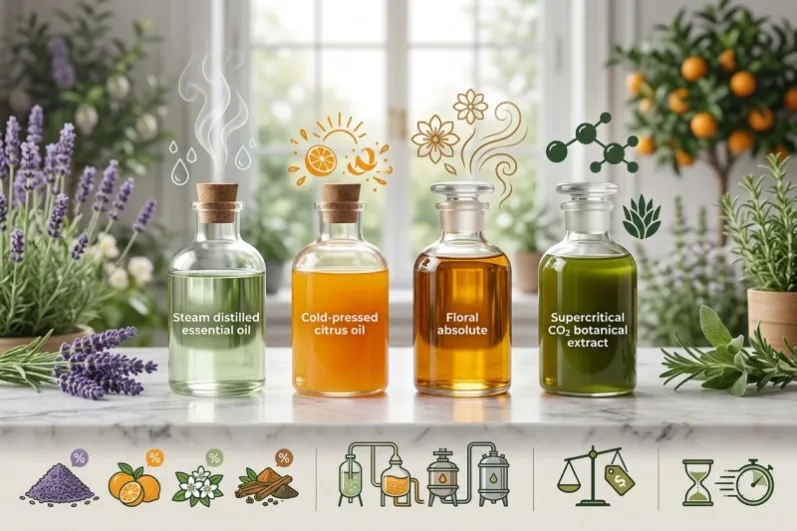
Essential oils are extracted by steam distillation, cold pressing, solvents, or CO₂. Each method suits different plants and affects aroma, composition, safety, and price.
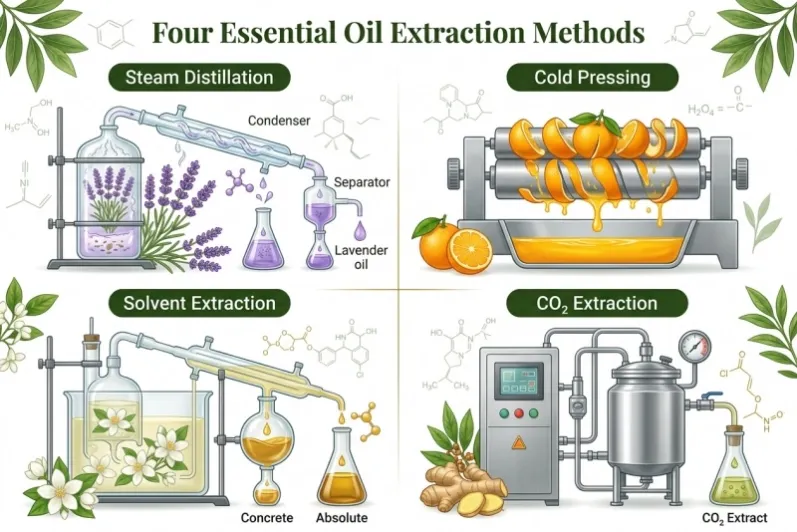
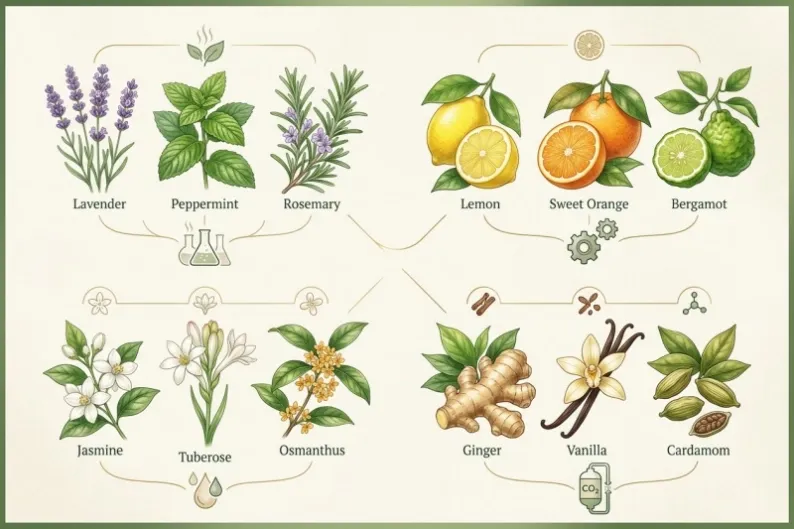
The aroma, composition, color, and price of natural aromatic ingredients depend not only on the plant species and origin but also on the extraction method. Common extraction methods include steam distillation, cold pressing, solvent extraction, and supercritical CO₂ extraction.
It is important to note that not all natural aromatic extracts can technically be called “essential oils.” For example, products obtained through solvent extraction are generally known as concretes or absolutes, while those produced using CO₂ extraction are usually called CO₂ extracts.
1. Steam Distillation
Steam distillation is the most widely used method for producing essential oils.
How It Works
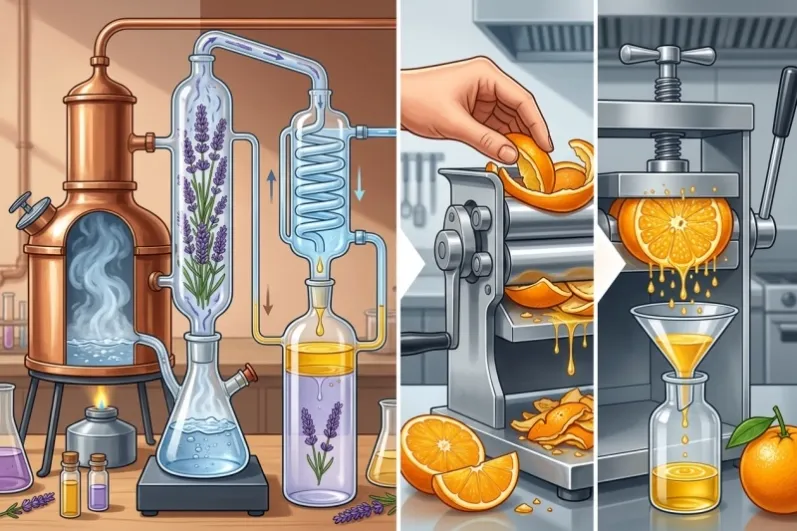
Steam passes through the plant material, causing volatile aromatic compounds to evaporate with the steam. The vapor is then condensed into a mixture of oil and water. The essential oil is separated from the water, while the aromatic water is often collected as a hydrosol.
Suitable Plant Materials
Steam distillation is suitable for plants that contain sufficient volatile compounds and can tolerate a certain level of heat, including:
- Lavender
- Peppermint
- Rosemary
- Tea tree
- Eucalyptus
- Patchouli
- Cedarwood
- Frankincense
Flowers such as rose and neroli can also be steam-distilled. However, their essential oil yields are usually very low, which contributes to their high prices.
Effects on Aroma and Composition
Steam-distilled essential oils generally have a clean, light, and volatile aroma. However, some heat-sensitive compounds may decompose, transform, or be lost during the process. As a result, the aroma of a distilled essential oil may not be exactly the same as that of the fresh plant.
2. Cold Pressing
Cold pressing is mainly used for citrus peels. It is also known as expression or mechanical extraction.
How It Works
Mechanical force is used to rupture or press the oil glands in the peel. The resulting liquid is then filtered, centrifuged, and separated to obtain the essential oil. Unlike steam distillation, the process does not normally involve high temperatures.
Suitable Plant Materials
Common cold-pressed essential oils include:
- Sweet orange
- Lemon
- Grapefruit
- Bergamot
- Lime
- Mandarin
Citrus essential oils are mainly stored in oil glands within the peel. Mechanical pressing helps preserve the fresh aroma of the fruit peel.
Effects on Aroma and Composition
Cold-pressed citrus oils usually smell fresher, fuller, and closer to the original fruit. In addition to volatile aromatic compounds, they may contain pigments, waxes, and non-volatile substances such as furanocoumarins.
Some cold-pressed citrus oils can be phototoxic, so relevant safety limits must be considered when they are used in products applied to the skin. Distilled citrus oils generally contain lower levels of certain non-volatile phototoxic compounds, although their aromas may differ from those of cold-pressed oils.
3. What Is the Difference Between Distillation and Cold Pressing?
Category | Steam Distillation | Cold Pressing |
|---|---|---|
Process | Steam carries volatile compounds out of the plant material, followed by condensation and separation | Mechanical force ruptures the oil glands in citrus peels |
Main raw materials | Flowers, leaves, herbs, woods, resins, and roots | Primarily citrus peels |
Heat involved | Uses steam and heat | Usually does not involve high-temperature distillation |
Aroma profile | Clean and light, sometimes with a characteristic distilled note | Fresh, full, and closer to fresh fruit peel |
Extracted components | Mainly volatile, steam-distillable compounds | May also contain pigments, waxes, and non-volatile compounds |
Appearance | Usually relatively clear | May have a more noticeable color |
Stability | Depends on the type of essential oil | Citrus oils are generally more prone to oxidation |
Key considerations | Heat may affect sensitive compounds | Some oils may be phototoxic |
For example, when comparing two types of lemon essential oil:
- Cold-pressed lemon essential oil: Smells fuller and more like fresh lemon peel.
- Steam-distilled lemon essential oil: Usually has a lighter aroma and contains lower levels of some non-volatile compounds.
Therefore, even when two products come from the same plant, oils obtained through different extraction methods should not automatically be regarded as identical ingredients.
4. Solvent Extraction
Some flowers are extremely delicate. Their aromas may change when exposed to heat, or their aromatic compounds may not be efficiently recovered through distillation. In these cases, solvent extraction may be used.
How It Works
A suitable solvent is used to extract aromatic compounds, waxes, pigments, and other components from the plant material. After the solvent is removed, the resulting material is called a concrete.
The concrete can then be washed with ethanol and filtered to remove waxes. After the ethanol is removed, the final aromatic material is known as an absolute.
Suitable Plant Materials
Solvent extraction is commonly used for:
- Jasmine
- Tuberose
- Osmanthus
- Gardenia
- Certain roses and other delicate flowers
Effects on Aroma and Price
Absolutes usually have rich, complex aromas that closely resemble the scent of fresh flowers. They are therefore widely used in high-end perfumes and fragrance products.
Because the production process involves several stages and requires strict control of residual solvents, absolutes are often more expensive than common steam-distilled essential oils. However, the final price also depends on the extraction yield, origin, quality grade, and market availability.
Technically, an absolute is a natural aromatic extract rather than a traditionally defined essential oil.
5. Supercritical CO₂ Extraction
Supercritical CO₂ extraction uses carbon dioxide as the extraction medium under carefully controlled temperature and pressure.
How It Works
Under supercritical conditions, CO₂ has properties of both a gas and a liquid, allowing it to penetrate plant materials and dissolve selected compounds. After extraction, the pressure is reduced, and the CO₂ returns to a gaseous state and separates from the extract.
Unlike conventional organic solvents, CO₂ normally does not leave solvent residues in the final product. The range of extracted compounds can also be adjusted by changing the temperature and pressure.
Suitable Plant Materials
CO₂ extraction is commonly used for:
- Ginger
- Vanilla
- Cardamom
- Black pepper
- Frankincense
- Chamomile
- Hops
- Calendula
Effects on Aroma and Price
CO₂ extraction generally operates at lower temperatures than steam distillation, helping preserve some heat-sensitive compounds. The resulting aroma is often fuller and closer to that of the original plant material.
However, CO₂ extracts may also contain waxes, resins, and other heavier compounds. Their appearance, texture, and flow characteristics may therefore differ from those of distilled essential oils.
Because the process requires specialized equipment and technical control, CO₂ extracts are often relatively expensive. However, they are not necessarily more expensive than every other type of natural extract.
6. How Do Extraction Methods Affect Aroma and Price?
Effects on Aroma
- Steam distillation: Produces a clean aroma, but heat may alter some sensitive compounds.
- Cold pressing: Preserves a fresh, bright, and full citrus peel aroma.
- Solvent extraction: Suitable for delicate flowers and produces rich aromas that closely resemble fresh blossoms.
- CO₂ extraction: Captures a broader range of compounds, often producing a full and well-rounded aroma.
Effects on Price
Price cannot be determined by the extraction method alone. Other important factors include:
- Cost of the plant material
- Extraction yield
- Country or region of origin
- Harvest season
- Equipment and energy costs
- Number of processing steps
- Degree of refinement
- Quality grade and market availability
For example, cold-pressed citrus oils usually have relatively high yields and are often affordable. Rose essential oil, however, remains extremely expensive despite being produced using the widely available steam-distillation process because it requires a large quantity of flowers and has a very low yield.
7. How Can You Confirm Whether an Ingredient Is Distilled or Cold-Pressed?
When purchasing natural aromatic ingredients, do not rely only on the product name. Ask the supplier to provide the following information:
- Botanical name
- Plant part used, such as peel, flower, leaf, wood, or root
- Extraction method
- Country or region of origin
- INCI name
- Certificate of Analysis, specification sheet, and Safety Data Sheet
- GC-MS analysis report
- Information about any additional processing, such as decolorization, deterpenation, rectification, or fractionation
For citrus essential oils in particular, confirm whether the product is:
- Cold-pressed or expressed
- Steam-distilled
Even when sourced from the same citrus fruit, oils produced through different methods may vary in aroma, chemical composition, color, phototoxicity risk, and recommended applications.
Conclusion
The main production methods for essential oils and natural aromatic extracts include steam distillation, cold pressing, solvent extraction, and supercritical CO₂ extraction.
- Most essential oils obtained from flowers, leaves, woods, and roots are produced through steam distillation.
- Citrus peel oils are usually produced through cold pressing.
- Delicate, heat-sensitive flowers are often processed using solvent extraction.
- CO₂ extraction may be used when a broader range of plant compounds needs to be preserved.
To determine whether an ingredient is distilled or cold-pressed, do not rely solely on its plant name or aroma. The extraction method, plant part, and technical documentation must all be reviewed.
No extraction method is inherently superior in every situation. The best choice depends on the desired aroma, product application, safety requirements, formulation needs, and budget.
Which Extraction Method do You Prefer?