Essential Oil Insights
How Can Essential Oils Be Made Water-Dispersible?
Essential oils can be water-dispersed using solubilizers, emulsifiers, or ethanol. Correct premixing, preservation, suitable ratios, and stability testing are essential.
Today, let’s discuss how natural essential oils can be modified into water-dispersible forms for incorporation into cosmetics and other water-based products.
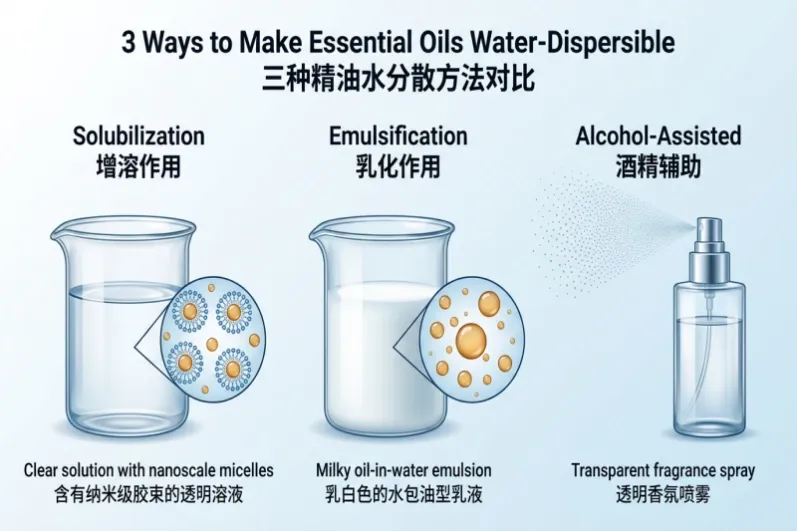
There are three main approaches, depending on the desired result: clear solubilization, milky emulsification, or alcohol-assisted solubilization.
Important: Essential oils do not truly dissolve in water. Solubilizers or emulsifiers are used to encapsulate and disperse the oil in water, creating a stable dispersion.
Method 1: Solubilization
Recommended for clear products and water-based fragrance sprays
A solubilizer forms nanoscale micelles, producing a clear appearance. This method is ideal for transparent, water-based fragrance sprays.
Common Ingredients
PEG-40 Hydrogenated Castor Oil
The most commonly used option and widely accepted for cosmetic formulations.
INCI: PEG-40 Hydrogenated Castor Oil
Polysorbate 20
Suitable for lighter essential oils, such as citrus and floral oils.
Polysorbate 80
Suitable for heavier woody and resinous oils, such as agarwood and patchouli.
Recommended Ratios by Weight
Solubilizer : essential oil = 2–3 : 1
For heavier essential oils, increase the ratio to 3–4 : 1.
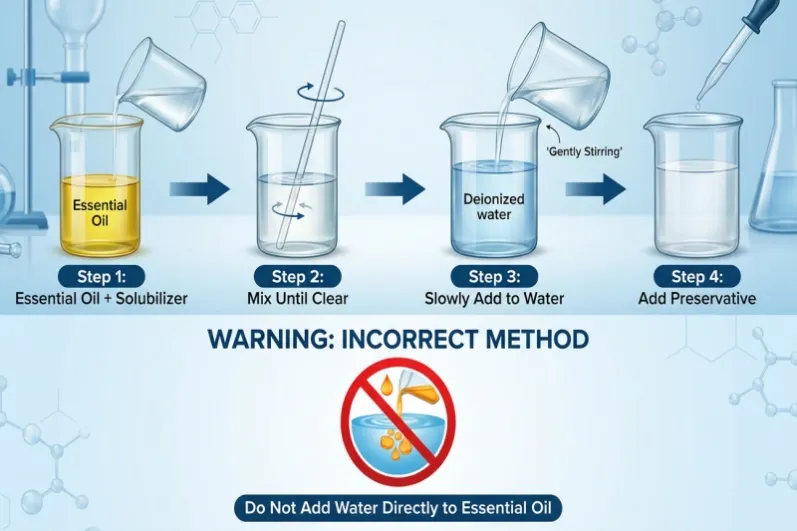
Example: Mix one part essential oil with three parts PEG-40 Hydrogenated Castor Oil. Blend until clear, then slowly add the premix to deionized water while stirring.
Processing Sequence
The order of addition is critical and must not be reversed.
- Combine the essential oil and solubilizer at room temperature. Stir until the mixture becomes completely clear to create a pre-solubilized oil phase.
- Slowly add the premix to the water while stirring continuously at low speed. Do not pour water directly into the essential oil mixture, as this can easily cause cloudiness and separation.
- Optional: Add 5–10% double-dealdehyded ethanol to improve fragrance diffusion. Add a suitable preservative at the end, as all water-based systems require preservation.
- Stir for 10–15 minutes, then allow the mixture to stand until any foam has disappeared.
Recommended Maximum
The total essential oil content should generally not exceed 5% of the formula. Higher concentrations are difficult to keep transparent.
Method 2: Emulsification
Produces a milky appearance and accommodates more essential oil
This method uses an oil-in-water (O/W) emulsifier to create micron-sized droplets. The final liquid appears milky white and is suitable for emulsion-type fragrance products, but it cannot remain transparent.
- Essential oil concentrations of 5–20% may be possible, significantly higher than in solubilized systems.
- Disadvantages: The product is not transparent and may develop floating oil or phase separation over time. Its stability is generally lower than that of a solubilized system.
Method 3: Alcohol-Assisted Solubilization
A simple option for fragrance sprays
Ethanol, preferably double-dealdehyded ethanol, is used as an intermediate solvent. The essential oil is dissolved in the alcohol before water is added.
Recommended ratio: Essential oil : ethanol = 1 : 8 to 1 : 10
Mix thoroughly, then slowly dilute with water.
Advantages: Simple and easy to process.
Disadvantages: High alcohol content may cause irritation, evaporates quickly, and is flammable. It may not be suitable for skincare products, and some consumers may dislike the smell of alcohol.
Common Mistakes to Avoid
The order of addition is critical.
Always premix the essential oil with the solubilizer before adding the mixture to water. Reversing the order can cause immediate cloudiness and separation.
Different essential oils behave differently.
Citrus oils are generally easier to solubilize. Heavy oils such as agarwood, patchouli, and vetiver usually require more solubilizer.
Water-based systems require preservatives.
Use a suitable preservative system, such as phenoxyethanol or potassium sorbate, to prevent microbial growth and spoilage.
Conduct stability testing.
Perform hot-and-cold cycling tests at 45°C and −5°C, then allow the product to stand for 7–14 days. Check for cloudiness, floating oil, precipitation, or phase separation.
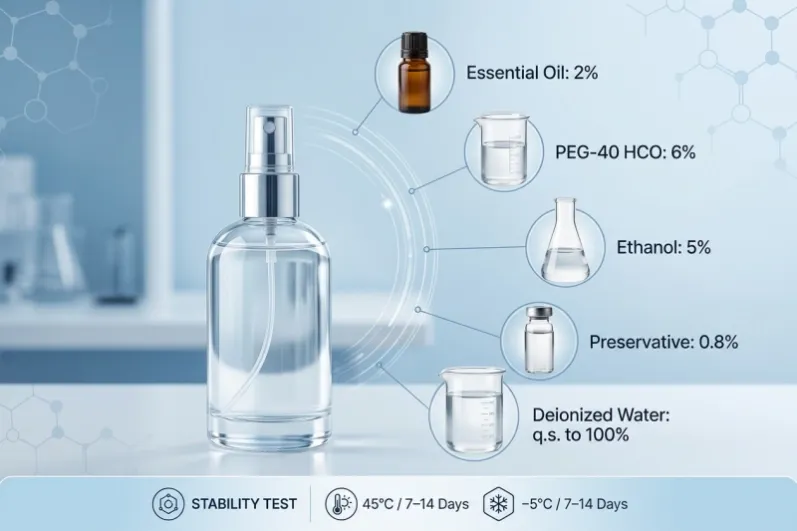
Sample Formula for a Clear, Water-Based Fragrance Spray
Total: 100 parts
Essential oil: 2 parts
PEG-40 Hydrogenated Castor Oil: 6 parts
Double-dealdehyded ethanol: 5 parts
Optional; improves evaporation and fragrance diffusion
Preservative: 0.8 parts
Deionized water: Add to 100 parts